
June 01, 2026
Preliminary research to understand the social-ecological development of Sado Satoyama Globally Important Agricultural Heritage System
SOKENDAI Student Dispatch Program program year: 2025
Nguyen Bich Ngoc
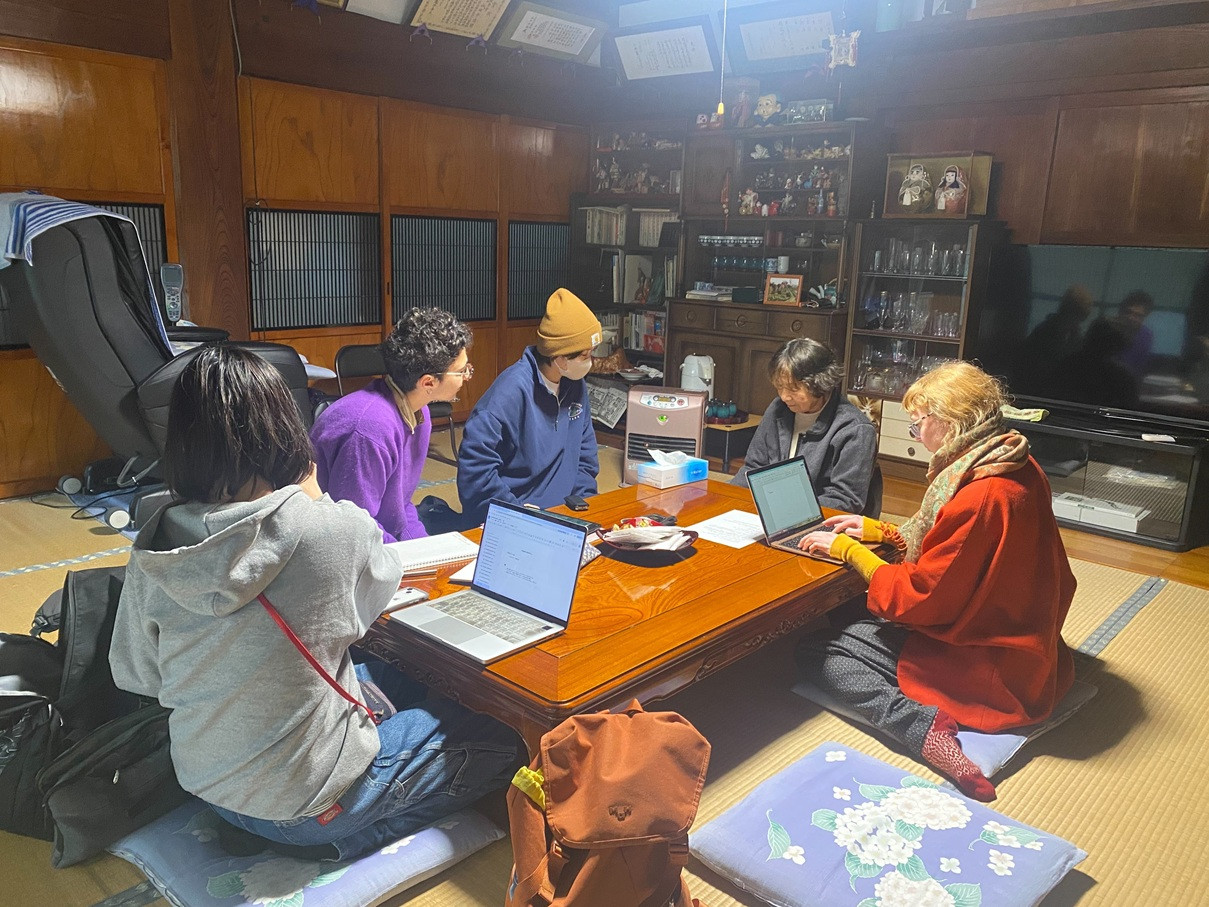
Interview with a retired farmer and current landlord (elder lady in black jacket) at her home in Hamochi, south of Sado Island on the change of her farming products and practices from past to present, on 6th February 2026.
The other participants include 2 local young people returning from Tokyo, acting as interpreters, and SATOCONN Project members (a fellow PhD student from France, and a professor from Niigata University)
Human activity has fundamentally reshaped the planet's ecosystems and climate, and this is most evident in the case of agriculture, which both depends on nature and transforms it. Across history, many traditional farming communities developed ways of working with natural systems rather than against them, sustaining biodiversity and landscape health across generations. The Food and Agriculture Organization's Globally Important Agricultural Heritage Systems (GIAHS) programme was established to identify and protect such traditional farming systems. Yet despite their international recognition, little is known about whether they succeed in balancing ecological and socio-economic goals and how values and voices are actually considered at the local level. This research tries to investigate these questions through the case of Sado Satoyama in Niigata Prefecture, Japan first GIAHS sites, designated in 2011, first by understanding how the social-ecological system of the island has evolved throughout history. To explore this, the researcher spent nearly one month on Sado Island conducting interviews with different people, including farmers, tourism workers, restaurant owners, and academics, combined with direct landscape observation, and reading of local documents and records.
The most significant insight from this preliminary fieldwork is that the GIAHS designation at Sado was driven primarily by realistic socio-economic motivations rather than purely ecological ones, revealing a gap between international framing and local reality. This finding suggests that the relationship between formal heritage recognition and on-the-ground social-ecological management is far more complex and context-dependent. It thus presents a problem going forward on how to then make branding and policies actually meaningful and inclusive to address local issues.Sado's case illustrates how communities facing depopulation, ageing, and economic decline are creatively mobilising cultural and ecological assets to remain viable, a dynamic relevant to many rural areas across the developed world.
This fieldwork represents the first phase of a three-year doctoral research project that will compare GIAHS management across multiple sites in Japan, aiming to build a broader understanding of how these systems function in different social, ecological, and economic contexts. The ultimate goal is to offer evidence-based recommendations for more effective and inclusive governance of agricultural heritage landscapes in the face of contemporary development pressures.
Period of Stay
Date of Departure: 2026/01/12
Date of Return: 2026/02/09
Country and/or City
Sado Island, Niigata Prefecture, Japan
Visiting Institute, Host, or Meeting
Sado Island Center for Ecological Sustainability, Niigata University
What you learned and achieved during the visit
Coming fresh from an “outsider” position both as a foreigner from a developing country learning about socio-ecological systems and their issues in a developed country such as Japan, and as a researcher from a more natural science background now doing more social science research, I’ve gained important academic and personal lessons.
The fieldtrip has helped me to have a more holistic and realistic understanding of how a socio-ecological system work and allowed me to gain experience in working with different types of people. I could understand why transdisciplinary research is even more complicated done than said.
Global Environmental Studies, Nguyen Bich Ngoc