
2026.07.16
An Anthropological study on Traditional farming landscapes and Living culture in Central Switzerland
SOKENDAI研究派遣プログラム 採択年度: 2026
Nguyen Bich Ngoc
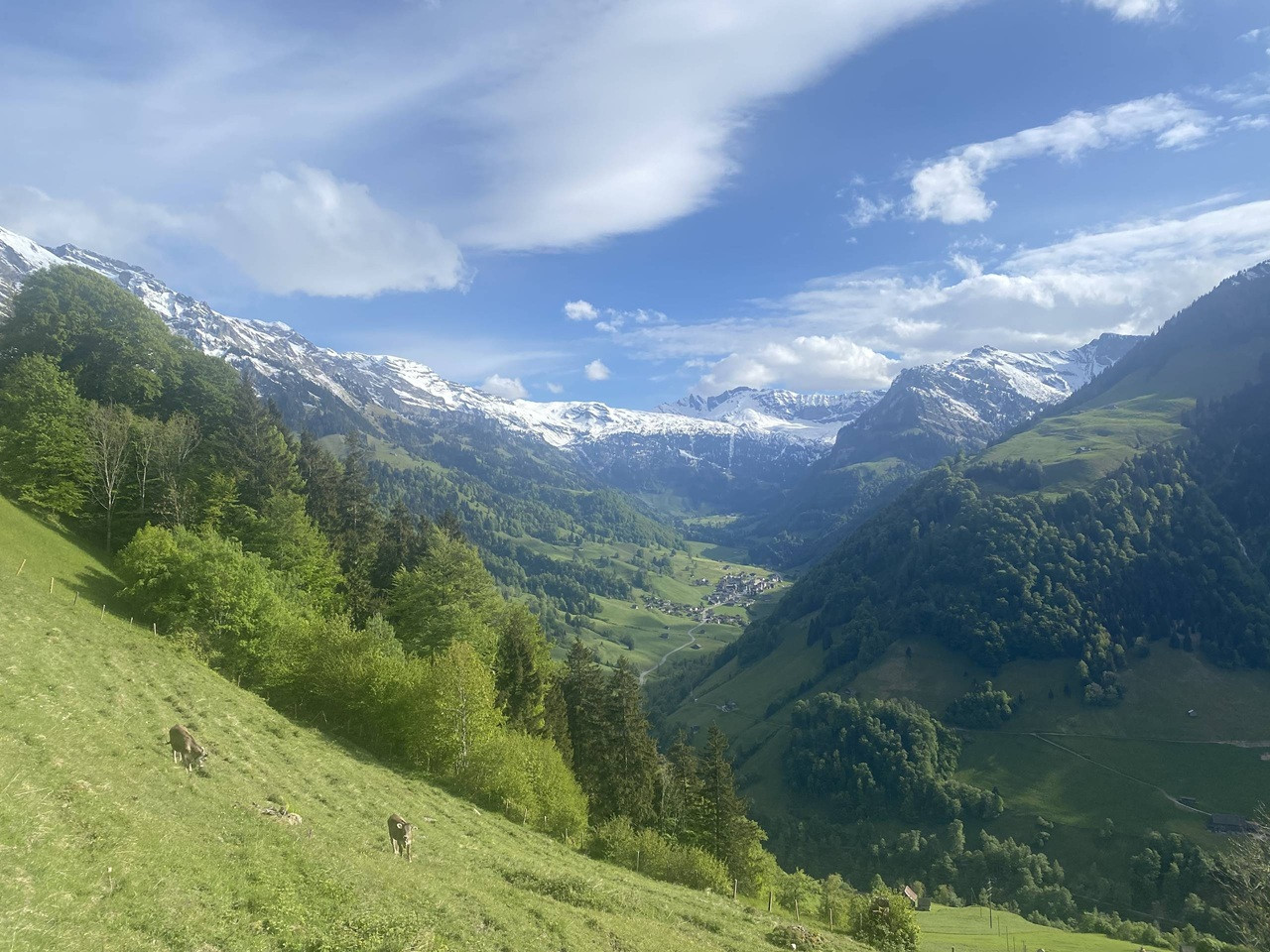
The picture was taken on the way down from a visit to an Alpine farmer on Sunday 17 May, 2026. The cows free ranging on Swiss Alps in the photo represent traditional Alpine transhumance in Switzerland where the livestock are moved up to the high mountain pastures in the summer.
Traditional farming landscapes shaped by centuries of human-nature interaction are disappearing worldwide. Alpine transhumance (Alpwirtschaft), the seasonal movement of people and livestock between valley farms and mountain pastures, recognised as UNESCO Intagible Cultural Heritage, is one such example. Transhumance is often managed by local commons who developed institutions known as Korporationen under common-property rights system dated back centuries before the foundation of Swiss federal state. The Korporationen are now trying to adapt to contemporary political, economic, and environmental changes in different ways to stay relevant. Swiss transhumance system shares various sustainability challenges with Japan's traditional satoyama landscapes, including rural depopulation, climate change, and economic pressures.
(Understanding how communities sustain these landscapes from the inside and from multiple perspectives requires ethnographic approaches, however, these methods lay outside my formal research background. To develop this competency, I undertook a one-month anthropological training at the Institute of Social Anthropology, University of Bern, using the SATOCONN project's living lab site in Sarnen, Obwalden, as my practice fieldsite.)
Through participant observation, in-depth interviews, and focus group discussions, I tried to understand living culture-nature interlinkages in the region historically rooted in Alpine transhumance practices. I found cultural traditions, such as yodelling and alphorn playing, have transitioned from practical herding strategies to now being forms of performing arts in a way, yet they remain emotionally and socially significant to communities today. Local younger generations showed awareness of local commons organisations (Korporationen), which collectively manage land in the region, but varied in their understanding and perception of Korporationen specific roles in landscape stewardship.
These ethnographic competencies and comparative insights will directly strengthen my PhD research on traditional agricultural landscape management that delivers ecological benefits in Japan, contributing to transdisciplinary knowledge for sustaining biodiversity-rich farming landscapes across cultures
派遣先滞在期間
Date of Departure: 2026/05/02
Date of Return: 2026/06/08
国、都市等
Bern & Obwalden, Switzerland
機関名、受入先、会議名等
Institute of Social Anthropology, University of Bern
派遣中に学んだことや得られたもの
This dispatch provided intensive, hands-on training in ethnographic methods — participant observation, in-depth interviewing, fieldnote writing, and qualitative coding, applied directly in a real-world research setting in Switzerland within an on-going international transdisclipnary research project entitled Satoyama Reconnections: Engaging Communities in Resilient, Nature- and Climate-positive Land Use Futures (RIHN, 2025-2028). I gained methodological skills and confidence beyond my previous natural-science- focused background and developed a richer comparative understanding of how farming communities sustain traditional landscapes across Switzerland and Japan. The experience has meaningfully shaped the qualitative dimensions of my ongoing PhD research design.
総合地球環境学コース Nguyen Bich Ngoc