
November 10, 2025
[Press Release] Antarctic ice melt triggers further melting: Evidence for cascading feedbacks 9,000 years ago
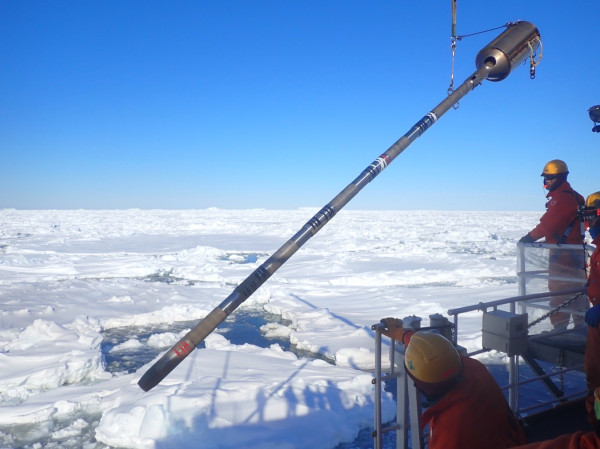
Marine sediment coring from the icebreaker Shirase during the 61st Japanese Antarctic Research Expedition (2019–2020).
A large cylindrical coring device is deployed vertically into the seafloor and recovered to obtain sediment cores.
A video of the field survey conducted on the Antarctic continent is available at:
https://drive.google.com/drive/folders/1LCU4BZKmyWbvjpklxHPYLZCTbRlSrDip?usp=sharing
credit: National Institute of Advanced Industrial Science and Technology (AIST)
Release Summary
An international team led by Japan’s National Institute of Polar Research discovered that large-scale East Antarctic ice loss around 9,000 years ago was amplified by a “cascading positive feedback” between meltwater and ocean circulation. Sediment records and ocean–climate modeling show that meltwater from other Antarctic regions strengthened warm deep-water inflow, accelerating ice-shelf collapse and inland thinning. The finding highlights how Antarctic ice melt can self-reinforce under ongoing global warming.
Information of the paper
- Title: Antarctic ice shelf collapse in Holocene driven by meltwater release feedbacks
- Authors: Yusuke Suganuma1,2, Takuya Itaki3, Yuki Haneda3, Kazuya Kusahara4, Takashi Obase5,4, Takeshige Ishiwa1,2, Takayuki Omori6, Minoru Ikehara7, Rob McKay8, Osamu Seki9, Daisuke Hirano1,2, Masakazu Fujii1,2, Yuji Kato7, Atsuko Amano3, Yuki Tokuda10, Hokuto Iwatani11, Yoshiaki Suzuki3, Motohiro Hirabayashi1, Hiroyuki Matsuzaki12, Takeyasu Yamagata12, Masao Iwai7, Kota Katsuki13, Francisco J. Jimenez-Espejo4,14, Hiroki Matsui15, Koji Seike3, Moto Kawamata2,16, Naohisa Nishida17, Masato Ito1, Shin Sugiyama8, Jun'ichi Okuno1,2,18, Takanobu Sawagaki19, Ayako Abe-Ouchi1,5, Shigeru Aoki8, Hideki Miura1,20
1 National Institute of Polar Research,
2 The Graduate University for Advanced Studies (SOKENDAI)
3 Geological Survey of Japan, The National Institute of Advanced Industrial Science and Technology
4 Japan Agency for Marine-Earth Science and Technology
5 Atmosphere Ocean Research Institute, University of Tokyo
6 The University Museum, University of Tokyo
7 Marine Core Research Institute, Kochi University
8 Antarctic Research Centre, Victoria University of Wellington
9 Institute of Low Temperature Science, Hokkaido University
10 Faculty of Environmental Studies, Tottori University of Environmental Studies
11 Faculty of Science, Yamaguchi University, Yamaguchi
12 Micro Analysis Laboratory, Tandem Accelerator (MALT), The University of Tokyo
13 Estuary Research Center, Shimane University
14 Instituto Andaluz de Ciencias de la Tierra, Consejo Superior de Investigaciones Científicas
15 Graduate School of International Resource Sciences, Akita University
16 Civil Engineering Research Institute for Cold Region, Public Works Research Institute
17 Department of Environmental Sciences, Tokyo Gakugei University
18 Joint Support-Center for Data Science Research, Research Organization of Information and Systems
19 Faculty of Social Sciences, Hosei University
20 Faculty of Economics, Aomori Public University - Journal: Nature Geoscience
- DOI: 10.1038/s41561-025-01829-7