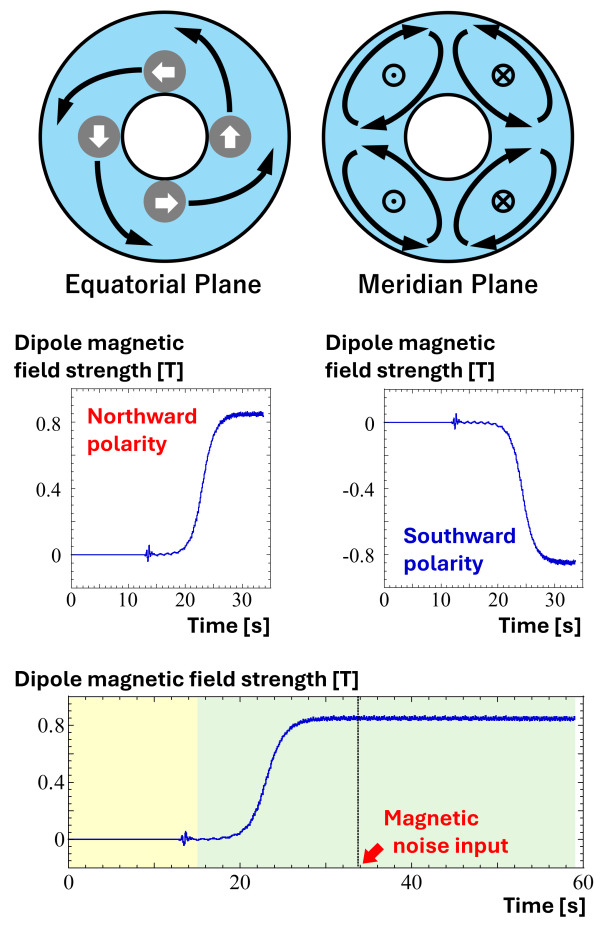
In the upper schematic, plasma occupies the light-blue region, and when a continuous driving force is applied at the locations indicated by the white arrows, convection is generated as shown by the black arrows. The middle panels show the growth of the dipole magnetic field for the northward-polarity and southward-polarity cases, respectively. The lower panel indicates the initial stage during which periodic small-amplitude reversals occur (light yellow region), followed by a stable stage in which the polarity becomes fixed (light green region). This panel also shows that even when a weak magnetic perturbation is imposed in the stable state, no significant change is observed.
Credit:
National Institute for Fusion Science
As is well known, the Earth behaves like a “giant magnet” (that is, it possesses a dipole magnetic field*1), and this magnetic field is thought to be generated by a dynamo process*2 driven by thermal convection of liquid iron in the Earth’s outer core. Paleomagnetism studies have shown that the Earth’s magnetic field reverses its polarity at irregular intervals, ranging from several hundred thousand to about ten million years. However, the physical mechanism responsible for these reversals remains unresolved. In particular, it is still not well understood how the polarity of the magnetic field - northward or southward - is determined.
Focusing on this polarity-determination mechanism, a research team at the National Institute for Fusion Science (NIFS) and the Graduate University for Advanced Studies, SOKENDAI, carried out a detailed study of a convective dynamo arising in a spherical-shell plasma having the same geometry as the Earth’s outer core, using three-dimensional magnetohydrodynamic simulations*3. As a result, they showed for the first time that, in an Earth-like dynamo, the polarity of the magnetic field (northward or southward) is determined randomly, not by the direction of convection, but by extremely weak magnetic perturbations present initially. Moreover, depending on subtle differences in the imposed magnetic perturbations, the system settles into either a northward - or southward- polarity state and remains there (bi-stability of the dipole polarity). Thus, the polarity of the Earth’s magnetic field may likewise have been determined by tiny fluctuations present when the geodynamo first emerged some four billion years ago. That polarity would then be expected to persist, yet in reality the geomagnetic field undergoes repeated reversals. This suggests that geomagnetic reversals may be caused by physical effects not included in the present computational model.
For Details (Eurekalert!)