
October 23, 2026
Studying Heavy Elements in The Universe Through Stars’ Chemical Composition
SOKENDAI Student Dispatch Program program year: 2026
Ainun Nahdhia Azhari
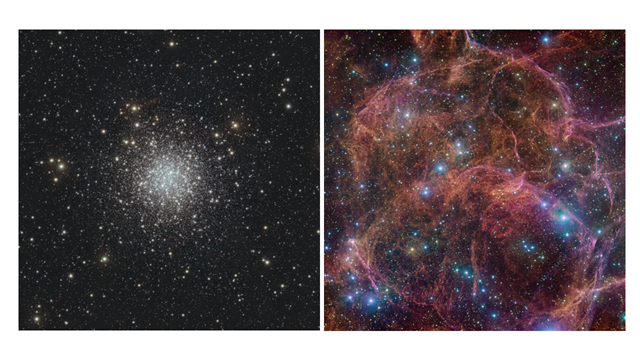
This image shows observations of the star cluster NGC 6723 with the Visible and Infrared Survey Telescope (left) and a supernova remnant observed with the Very Large Telescope (right), both operated by the European Southern Observatory (ESO). The star cluster image shows a group of thousands to millions of stars that formed together and have similar ages, and the supernova image shows the cloud of gas expelled after a star's death. Credit: ESO Image Public Archive (https://www.eso.org/public/images/) ESO/S. Meingast et al. and ESO/VPHAS+ team
How are heavy elements created in the universe? Many elements such as iron are created in stars through nuclear reactions. Other elements, called the “heavy elements”, are created at the end of a star’s life through an explosive event called a supernova and star mergers. Gas containing heavy elements forms later generations of stars, and by studying the star’s chemical composition, we can understand how the heavy elements are formed in the explosive events. Some are very difficult to detect, so their production is not understood very well; for example, Thorium (Th) and Europium (Eu). Their abundance ratio (Th/Eu) in stars tells us how much they are produced in explosive events, and the star’s age tells us when the events took place.
For this, I study clusters of stars (i.e., stars with similar ages) at various ages. I find that stars in a cluster have uniform Th/Eu ratios, and clusters of different ages have different Th/Eu ratios. This might hint that different explosive events play a role in Th/Eu production at different times; for example, older stars may contain more contribution from star mergers than supernovae compared to young stars. This result will help improve the understanding of how explosive events produce heavy elements before cluster formation.
Period of Stay
Date of Departure: 2026/04/28
Date of Return: 2026/07/07
Country and/or City
Heidelberg, Germany
Visiting Institute, Host, or Meeting
Astronomisches Rechen-Institut, Zentrum für Astronomie der Universität Heidelberg Dr. Tadafumi Matsuno
What you learned and achieved during the visit
During the visit, I learned how to conduct research effectively. With my host, I learned about planning the analysis, identifying the steps to be done, how to examine the data, how to interpret the results, and how to brainstorm ideas for discussing the results for publication. I also learned to build networks by meeting other researchers and discussing my work, which opens the possibilities for future collaborations.
Astronomical Science Ainun Nahdhia Azhari