[Press Release]Unveiling an anomalous electronic state opens a pathway to room-temperature superconductivity
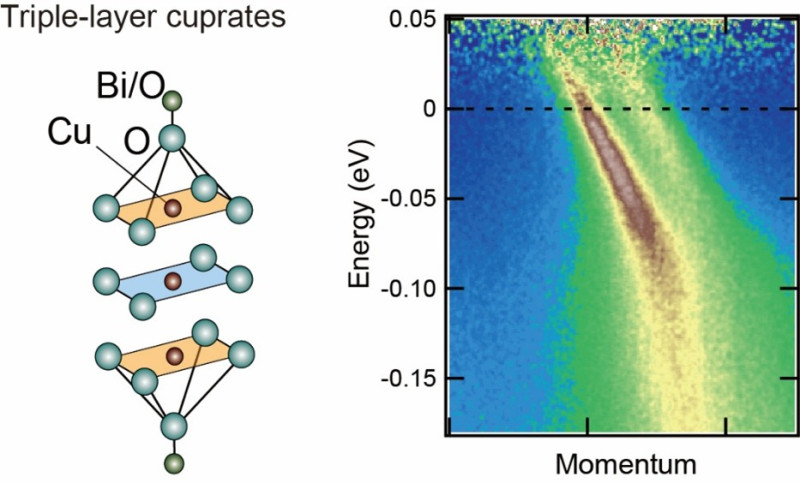
Crystal and electronic structures in the triple-layer cuprate superconductor
Triple-layer cuprate superconductors have three copper oxide planes, two outer (orange) and one inner (blue) plane (left). These two types of copper (Cu)-oxygen (O) planes show two quasiparticle bands as observed in the high-resolution angle-resolved photoemission spectroscopy (right).
Credit: Adapted from Ideta et al. (2025), Nature Communications, CC BY-NC-ND 4.0
Restriction: News organizations may use or redistribute this image, with proper attribution, as part of news coverage of this paper only.
Release Summary
Superconductive materials can conduct electricity with no resistance, but typically only at very low temperatures. Realizing superconductivity at room temperature could enable advanced, energy-efficient electronics and other technologies. Now, an international research team is one step closer to such an achievement. The researchers made the first observation of a special electronic state known as a “nodal metal,” which provides more insight into electronic behavior at different temperatures, in a multilayer system comprising copper and oxygen.
The team, which includes researchers based in Japan, Taiwan and the United States, published their results on Oct. 27 in Nature Communications.