[Press Release] The Gold Standard: Researchers End 20-Year Spin Debate on Gold Surface with Definitive, Full-Map Quantum Imaging
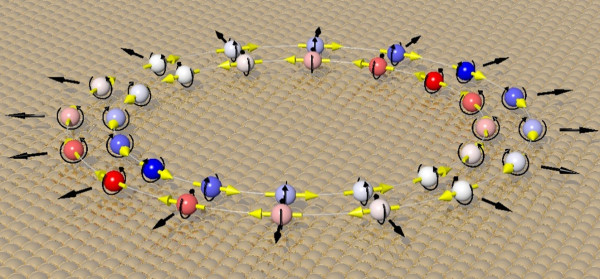
The behavior of electrons on a single-crystal gold surface was investigated. On the Au(111) surface, a difference in the magnitude of the electrons' in-plane momentum component (proportional to the in-plane velocity) is observed, which depends on their spin orientation. The two opposite assignments for the orientation of the spin were left unresolved for 20 years. Ultimately, the spin orientation and the shape of the electron's orbit were determined by measuring the two-dimensional photoelectron momentum distribution.
Credit: Fumihiko Matsui
Restriction: News organizations may use or redistribute this image, with proper attribution, as part of news coverage of this paper only.
Release Summary
Researchers at the Institute for Molecular Science (IMS) have definitively resolved a two-decade-long controversy regarding the direction of electron spin on the surface of gold. Using a state-of-the-art Photoelectron Momentum Microscope (PMM) at the UVSOR synchrotron facility, the team captured complete two-dimensional snapshots of the Au(111) Shockley surface state, mapping both the electron’s spin (its intrinsic magnetic property) and its orbital shape in a projection-based measurement. The experiment unambiguously confirmed the Rashba effect—where an electron's motion is coupled to its spin—by assigning a clockwise (cw) spin texture to the outer electron band and a counter-clockwise (ccw) texture to the inner band when viewed from the vacuum side. This work establishes a robust, trustworthy reference dataset for spin-resolved photoemission, paving the way for the development of highly efficient spintronic devices.