[Press Release] How 'asymmetric alloying' is creating the next generation of luminescent materials
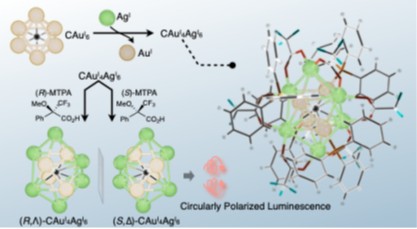
Proposed asymmetric synthesis approach The addition of silver trifluoroacetate to a triphenylphosphine-protected CAuI6 cluster creates a chiral-at-carbon hexasilver(I)-alloyed tetragoldmethane (CAuI4AgI6) cluster through etching of two gold(I) atoms. Further, selective asymmetric synthesis can be achieved by utilizing homochiral carboxylate ligands. Credit: Professor Mitsuhiko Shionoya and Dr. Xiao-Li Pei from Tokyo University of Science, Japan, and Professor Masahiro Ehara from Institute for Molecular Science and SOKENDAI, Japan License type: Original content Restrictions: Cannot be reused without permission.
Release Summary
The development of atomic level molecular editing methods for metal clusters is an important avenue in synthetic chemistry that can expand the structure diversity and functionality of these compounds. In a new study, researchers have developed a novel, highly selective asymmetric synthesis approach to develop chiral optical metal clusters with photoluminescence. This approach can contribute to the development of chiral luminescent nanomaterials, benefiting several industries.
Title: Asymmetric alloying for heterogeneous metal-ion clusters of chiral-at-carbon CAuI4AgI6 polyhedra exhibiting red to near-infrared photoluminescence